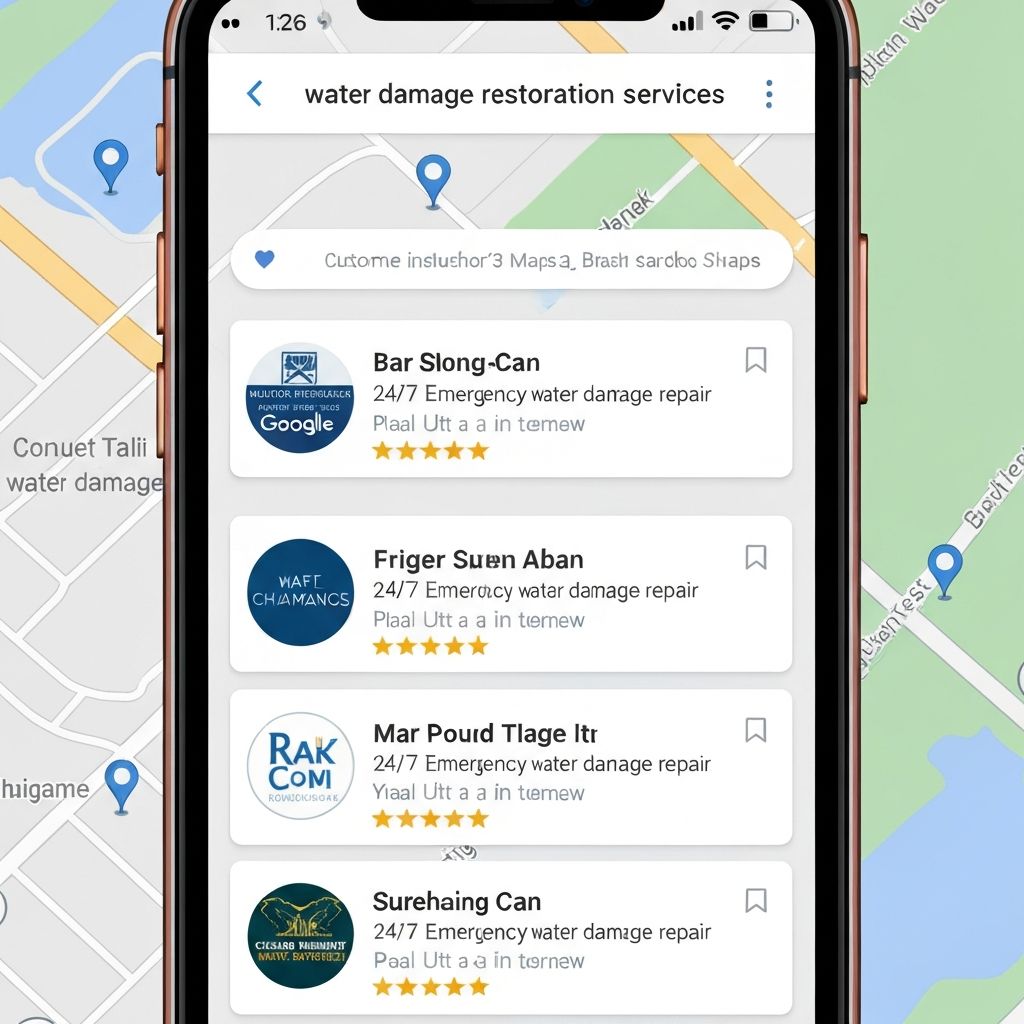
When a homeowner discovers water flooding their basement at 2 AM, they don't browse multiple websites comparing services. They grab their phone, open Google, and search for immediate help. That search increasingly leads them directly to Google Maps—and the statistics prove it.
Key Statistic
50% of water damage leads
begin with a Google Maps search, making local visibility the single most important factor in capturing emergency restoration customers.
The Mobile-First Emergency Search Behavior
Water damage emergencies happen at all hours, and affected property owners need immediate assistance. This urgency creates a specific search pattern that favors Google Maps:
- Mobile dominance: 76% of water damage searches happen on mobile devices, where Google Maps results appear first
- Location-based intent: Users want nearby services that can respond quickly
- Visual decision-making: Map listings with photos, reviews, and clear contact information build instant trust
- One-click calling: Google Maps provides instant phone access without visiting websites
This behavior shift explains why traditional website SEO alone is no longer sufficient. Your Google Business Profile has become your most important digital asset for lead generation.
How Google Maps Prioritizes Restoration Companies
Understanding Google's local search algorithm helps you optimize your presence effectively. Google Maps rankings depend on three primary factors:
1. Relevance: Does Your Profile Match the Search?
Google analyzes your business information to determine if you're relevant to the search query. For water damage restoration, this means:
- Clear business category selection (Water Damage Restoration Service as primary)
- Comprehensive service descriptions mentioning specific emergency services
- Regular posts about water damage, flood cleanup, and emergency response
- Keywords in your business description that match common search terms
Many restoration companies select generic categories like "Contractor" or "Cleaning Service," which reduces their visibility for water damage-specific searches. Precision matters.
2. Distance: How Close Are You to the Searcher?
Google prioritizes businesses closest to the searcher's location. You can't change your physical location, but you can optimize your service area definition:
- Set accurate service areas in Google Business Profile
- Create location-specific landing pages on your website
- Mention specific neighborhoods and communities you serve
- Use geo-tagged photos from job sites across your service area
"Proximity signals are weighted heavily in emergency searches. If Google sees you actively serving multiple neighborhoods, your visibility increases across your entire service area."
3. Prominence: How Well-Known and Trusted Is Your Business?
Prominence combines multiple trust signals:
- Review quantity and quality: More positive reviews improve rankings and conversion rates
- Review recency: Fresh reviews signal active business operations
- Review response rate: Engaging with all reviews demonstrates professionalism
- Online citations: Consistent business information across directories
- Website authority: A well-optimized website linked to your Google Business Profile
Pro Tip: The Review Velocity Factor
Google weighs recent reviews more heavily than older ones. Aim for at least 3 new reviews per week to signal business momentum. Companies with consistent review generation rank higher than those with more total reviews but no recent activity.
Why Traditional Website SEO Isn't Enough Anymore
Many restoration companies invest heavily in website SEO while neglecting Google Maps optimization. This strategy misses half the opportunity:
- Search results layout changed: Google Maps listings appear above traditional organic results on mobile searches
- Direct conversion path: Users can call from Maps without visiting your website
- Visual differentiation: Photos and reviews in Maps listings attract more clicks than text-only website listings
- Voice search optimization: "Near me" searches increasingly rely on Maps data
This doesn't mean website SEO is unimportant—it's essential for building authority and supporting your Maps rankings. But the priority has shifted. Your Google Business Profile is now your primary lead generation tool.
Optimizing Your Google Business Profile for Maximum Lead Capture
Based on data from hundreds of restoration companies, these optimization tactics deliver measurable results:
Complete Every Profile Section (Yes, Every Single One)
Google rewards profile completion. Businesses with 100% complete profiles rank higher and get more engagement:
- Add all service categories relevant to your business
- Write a detailed business description (750 characters maximum—use them all)
- List specific services with descriptions
- Add business hours including emergency availability
- Upload high-quality photos (at least 3 new photos per week)
- Include virtual tour or video if possible
Master the Google Posts Strategy
Google Posts appear directly in your Maps listing and signal active business management. Post weekly with this structure:
- Before/after photos: Visual proof of your work builds trust instantly
- Location-specific content: "Emergency water damage cleanup in [neighborhood]"
- Service keywords: Include terms people actually search for
- Call-to-action: "Call now for 24/7 emergency service"
Example Effective Google Post
"Completed emergency water damage restoration in Palm Beach Gardens last night. Basement flood cleanup finished in 4 hours. 24/7 emergency response available. Call now: (555) 123-4567"
[Include before/after photo tagged with location]
Implement a Systematic Review Generation Process
Reviews are the single most powerful ranking factor you can directly influence. Develop a process to request reviews from every satisfied customer:
- Ask for reviews within 24 hours of job completion (response rates are highest immediately)
- Provide direct review links via text message (make it as easy as possible)
- Train customers to mention specific services and locations in their reviews (increases keyword relevance)
- Respond to every review within 24 hours (positive and negative)
- Use review management tools to track and automate the process
Optimize Your Photos for Local Search
Photos significantly impact click-through rates from Maps listings. Follow these best practices:
- Geo-tag all photos: Include location metadata for local search relevance
- Upload job site photos weekly: Fresh content signals active business
- Show your team in action: Builds trust and humanizes your business
- Include before/after comparisons: Demonstrates results
- Add captions with keywords: "Water damage cleanup in Delray Beach, FL"
Tracking Your Google Maps Performance
Optimization without measurement is guesswork. Google Business Profile Insights provides crucial data about how customers find and interact with your listing:
- Search queries: What terms bring people to your profile
- Discovery method: Direct searches vs. discovery searches
- Customer actions: Website clicks, direction requests, phone calls
- Photo views: Which images attract the most engagement
Monitor these metrics monthly and adjust your strategy based on what's working. The companies that consistently analyze and optimize their Maps presence dominate their local markets.
Common Google Maps Optimization Mistakes
Avoid these frequent errors that hurt your rankings:
Incomplete or Inconsistent NAP Information
Your Name, Address, and Phone number must be identical across your website, Google Business Profile, and all online directories. Inconsistencies confuse Google and hurt your rankings.
Neglecting Review Management
Letting negative reviews go unanswered or failing to request reviews from satisfied customers damages your reputation and rankings. Address every review promptly and professionally.
Using Generic Business Categories
"Contractor" or "Cleaning Service" are too broad. Use specific categories like "Water Damage Restoration Service," "Fire Damage Restoration Service," and "Mold Removal Service" as applicable.
Inactive Google Business Profile
Profiles that go months without updates signal abandoned businesses. Post weekly, add photos regularly, and respond to reviews consistently to maintain active status.
Warning: Fake Reviews
Never purchase fake reviews or use review-gating practices. Google's algorithm detects these tactics and penalizes violators with ranking drops or profile suspension. Build genuine reviews from real customers.
The Competitive Advantage of Early Adoption
Many restoration companies still don't fully optimize their Google Maps presence. This creates an opportunity for those who understand the platform's importance:
- First-mover advantage: Dominating Maps in your area before competitors wake up
- Compounding review benefits: Early review generation creates momentum that's hard to overcome
- Algorithm favor: Consistently optimized profiles maintain rankings even as competition increases
The restoration companies capturing the majority of water damage leads today are those who prioritized Google Maps optimization 6-12 months ago. Start now to claim your market position before competitors do.
Conclusion: Maps First, Everything Else Second
The data is clear: Google Maps has become the primary discovery channel for water damage restoration services. Half of your potential customers start their search there, and that percentage continues to grow.
Businesses that optimize their Google Business Profile, systematically generate reviews, post regular updates, and maintain consistent local citations capture disproportionate market share. Those who treat Maps as an afterthought lose leads to better-optimized competitors—even if their actual service quality is superior.
Your Google Maps presence isn't just another marketing channel. It's your digital storefront, your first impression, and increasingly, your primary lead generation engine. Treat it accordingly.
Quick Action Checklist
- 1Complete 100% of your Google Business Profile sections today
- 2Set up a system to request reviews from every satisfied customer
- 3Upload 3 new geo-tagged photos this week
- 4Create your first Google Post with before/after photos and location keywords
- 5Verify your NAP consistency across all online directories
Ready to Dominate Google Maps in Your Market?
Our restoration marketing experts specialize in Google Maps optimization that delivers measurable results. Let us help you capture the 50% of leads starting their search on Maps.

Matt Gregory
CEO & Co-Founder, Apex Era Inc.
Matt Gregory is a restoration industry veteran and digital marketing expert who founded Apex Era to help restoration companies dominate their local markets. With extensive experience in Google Maps optimization and local SEO, Matt has helped hundreds of restoration businesses achieve measurable growth through strategic Maps presence.
Learn More →Get Weekly Local SEO Tips
Join restoration contractors receiving actionable Google Maps optimization strategies, industry insights, and lead generation tactics delivered every week.
Related Articles
Ranking Restoration Companies on Google Maps
Learn the technical implementation of schema markup and other tactics to improve your Maps rankings.
Maximizing Online Presence for Water Damage Restoration
Comprehensive guide to SEO, content marketing, and digital visibility for restoration companies.
Ready to Grow Your Business?
Get a free marketing consultation
Let our restoration marketing experts help you dominate your local market and generate more high-quality leads.